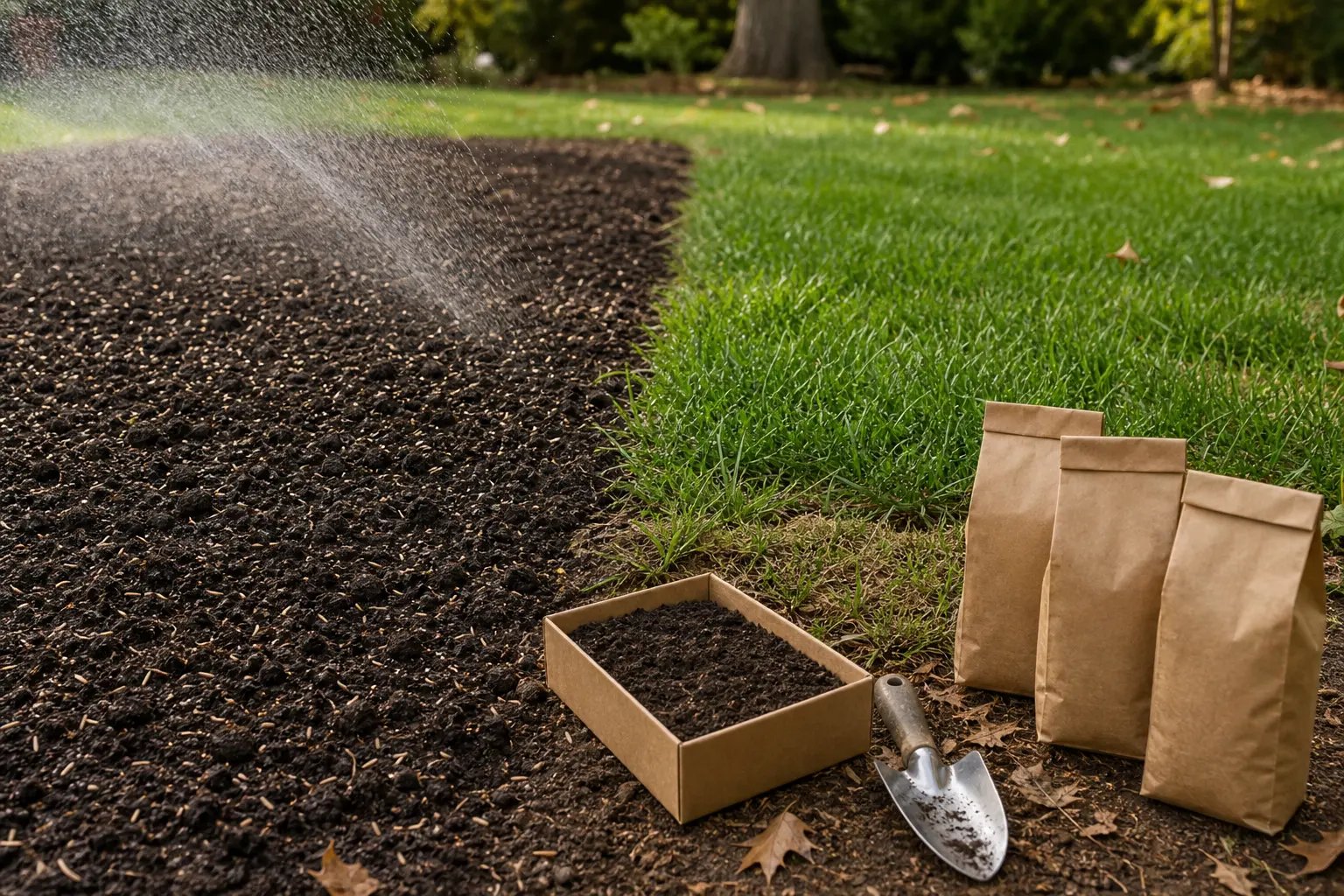
Seed now if the window is right. Don’t guess at lime or phosphorus.
If you are in a suitable local fall window for **cool-season grass**—the types commonly seeded in northern lawns—do not lose the week deciding whether every bag beside the seed display is required. The parts of establishment that cannot wait are a prepared seedbed, quality seed making direct contact with soil, and steady surface moisture through germination.
Lime and products bought mainly for phosphorus are a separate decision. A lawn soil test measures pH and plant-available nutrients, then provides fertilizer and lime recommendations. S4 That is more useful than treating a starter-fertilizer label as a required step.
This advice is for fall seeding of cool-season turf. If your lawn is warm-season grass, or local conditions are outside a favorable planting period, check timing with your local Extension office before using this sequence.
Starter fertilizer depends on what you are establishing—and what the soil needs
“Starter fertilizer” is a product category, not a universal yes or no.
Illinois Extension says high-phosphorus starter fertilizer is necessary only when a soil test identifies phosphorus deficiency. S1 Maryland Extension similarly directs homeowners to apply fertilizer according to soil-test results and applicable fertilizer law; its guidance allows phosphorus-containing starter fertilizer for a new lawn or soil testing low in phosphorus. S2
There is real regional variation. Penn State’s lawn-establishment guidance includes starter fertilizer near seeding, while still keeping phosphorus, potassium, and lime tied to soil-test recommendations. S5 The practical conclusion is simple: do not assume the bag is wrong, but do not assume it belongs in every project either.
Check your state and local fertilizer restrictions before applying phosphorus. Rules may treat overseeding established turf differently from creating a new lawn. A product on a local shelf does not settle whether that use is allowed. Follow the product label and the rules where you live.
Lime corrects pH; it is not a seeding ritual
Lime changes soil pH. The right material and rate depend on measured pH and the soil-test recommendation. S2S4 It is not a quick green-up product, and applying it “just in case” can create nutrient problems rather than solve one.
If your report does not call for lime, skip it. Seeding itself does not create a need for it.
Pick the lane that fits your week
**You have a recent, representative soil test.** Use the report for the area you are seeding. Follow its recommendations for lime, phosphorus, potassium, and other amendments, along with the product label and local rules. A report from a sunny front lawn may not answer the question for a shaded, compacted side yard.
**You sent a sample, but the results are pending.** If the local cool-season window is right, prepare and seed the area. Hold lime and high-phosphorus decisions until the report arrives unless qualified local guidance tells you otherwise. Nebraska Extension places soil testing early in overseeding and ties compost and other amendments to the test result. S3
**You have no test and need to seed now.** Do the seeding work well, then collect and submit a representative sample from the area you seeded. Avoid guessing at lime or phosphorus in the meantime. Record anything already applied this season so the recommendation has useful context.
Compost belongs in the same conversation when you are considering it as a soil amendment rather than a light topdressing. Nebraska Extension advises using test results to decide whether compost or other amendments are needed. S3
Make the soil test answer your actual question
Take samples from the area you plan to seed, not one convenient scoop beside the driveway. Soil testing connects the pH and plant-available nutrients in that soil to fertilizer and lime recommendations. S4
Keep clearly different areas separate when practical. A damp low spot, a dry patch beneath mature trees, and an open sunny renovation area may not share the same limitation. Fertility also will not fix deep shade, poor drainage, or soil compaction.
Before you shop, photograph any old soil report and note recent fertilizer, lime, compost, or manure-based applications, including the product analysis, rate, and date. Measure the project area as well. Those details make it easier to apply a recommendation accurately and keep material off pavement, where rain can carry it away.
The next move: protect the appropriate seeding window, submit the sample, and let the report—not the bag design—choose whether lime, phosphorus, potassium, or compost belongs in the plan.