The short answer: protect the new grass first
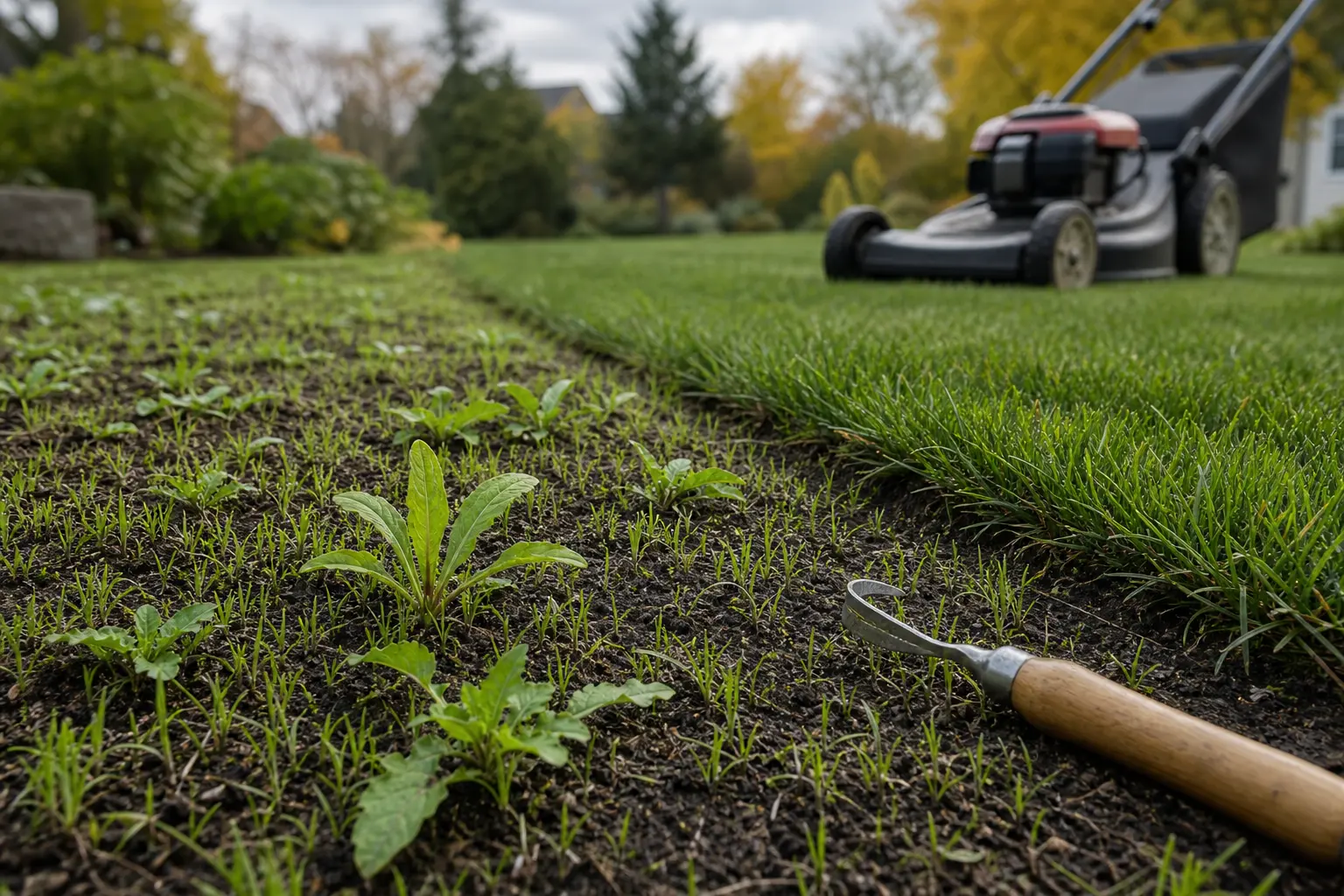
If the new lawn is coming in and a handful of weeds are already taller than the seedlings, pull the scattered offenders or mow them when the grass is ready. Do not rush to spray simply because the weeds won the first footrace.
Soil disturbance from seeding commonly brings weed seeds to the surface. Some early weeds become less noticeable after a few proper mowings, while the young turf begins to fill in. University of Maryland Extension recommends manual removal where practical and notes that some weeds decline after several mowings. S1
The decision changes if weeds are widespread, persistent, or clearly preventing the grass from establishing. Even then, identify the weed and clear the maturity requirements on the exact product label before treating. Newly established turf is sensitive to many herbicides, and Penn State advises avoiding applications unless the infestation is severe and you are sure the product will not interfere with turf growth. S2
Use three lanes, not one panic button
- **A few scattered weeds:** Pull or scrape them, ideally when the soil is moist enough that roots release without excavating half the seedbed. This is often the cleanest option while seedlings are small. S1
- **Weeds that are annoying but mow down:** Mow correctly once the new grass is ready, then reassess after a couple of mowing cycles. A temporarily imperfect new lawn is not a failed new lawn.
- **Widespread or persistent weeds:** Take a close photo, determine whether they are broadleaf weeds or grassy weeds, and consider a targeted, lawn-labeled treatment only after the turf meets that product’s establishment requirements. Spot treatment can reduce pesticide use and the chance of collateral turf injury. S4
A broadleaf herbicide will not solve a grassy-weed problem. And a pre-emergent herbicide—one that stops seeds from germinating—can conflict directly with fresh seeding unless its exact label expressly allows use at your lawn’s current establishment stage. S4
Count successful mowings, not calendar days
The useful question is not, “How many days ago did I seed?” It is, “Has the slowest part of this lawn rooted, reached mowing height, and been mowed successfully?”
For general post-seeding guidance, University of Maryland Extension advises waiting until after three mowings before using a broadleaf herbicide and after four mowings before using a grassy-weed pre-emergent. Those are useful guardrails, not permission to ignore the product label. S1
Labels can set different gates. One 2,4-D turf label, for example, defines well-established newly seeded grass as reaching at least the five-leaf stage and includes a reseeding restriction after treatment. That is an example of why there is no universal “safe after X weeks” rule. The exact label, your turf species, and applicable state and local requirements control. S3
If the label does not clearly allow use on your type and stage of newly seeded turf, wait. The weeds may be inconvenient; restarting thin or injured grass is worse.
Keep the lawn moving while you wait
Mow with a sharp blade once the grass is ready, and avoid removing more than one-third of the leaf blade in a single mowing. Keep traffic off tender areas as much as practical. S1
Continue watering for the establishment stage rather than treating every dry-looking patch as a weed problem. What matters most now is whether desirable grass is steadily filling in. If it is not, look first at moisture, seed-to-soil contact, shade, washout, or traffic before assuming weeds are the main reason.
Before you buy or spray anything, write down the mow count for the slowest-growing area, photograph the weed up close, and compare this week’s turf density with last week’s. That small record makes the next decision clearer—and is far more useful than trying to negotiate with every weed individually.