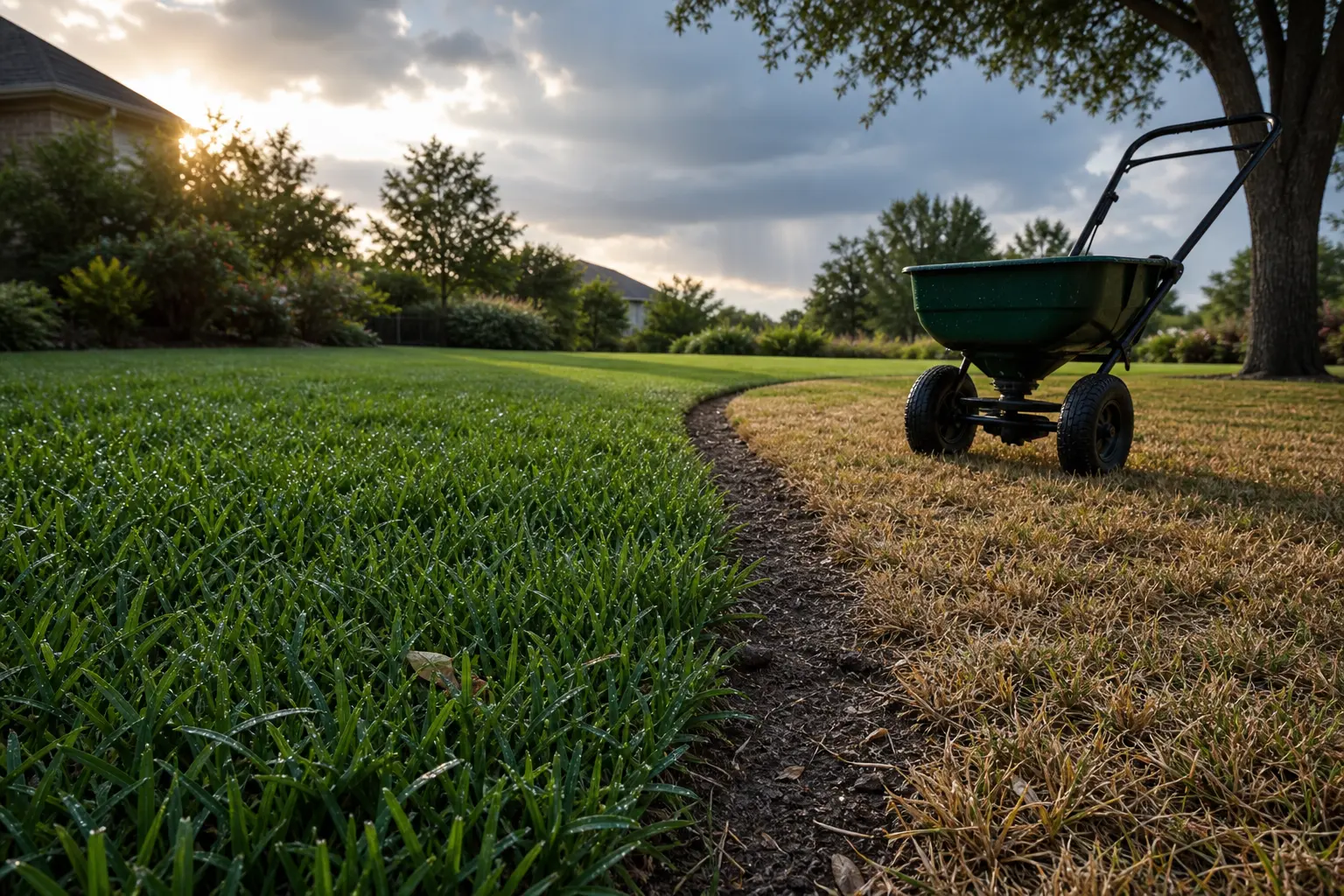
Start with the lawn, not the bag
If you are deciding whether to fertilize this weekend, first ask one question: is this cool-season grass waking up for fall, or warm-season grass beginning to slow down? Late August is not one national fertilizer holiday. The same bag can be sensible timing for one lawn and a late-season nudge the other lawn does not need.
Cool-season lawns include tall fescue, Kentucky bluegrass, perennial ryegrass, and fine fescues. Warm-season lawns include bermudagrass, zoysiagrass, centipedegrass, and buffalograss. Those groups run on different seasonal clocks. S1
If you have cool-season grass, watch for recovery
Cool-season turf commonly slows during summer heat and drought, then resumes shoot growth as fall conditions become more favorable. In Minnesota, Extension places cool-season fertilization broadly from early August through mid-October, while emphasizing that weather and local conditions set the real schedule. S3
That does not mean fertilize a lawn that still looks parched and checked out. Wait until it has moisture and visible active growth—new green growth, improved density, and a return to normal mowing—rather than treating the calendar as proof that the lawn is ready. Oklahoma State advises waiting for cool-season lawns to resume active growth as temperatures moderate. S1
If recovery is underway, this can be the beginning of your useful fall feeding period. If heat and drought are still running the show, waiting is usually the better call. Fertilizer is not a wake-up call for dormant grass; it is more like leaving a voicemail for someone who has turned off the phone.
If you have warm-season grass, the window is closing
Warm-season turf is different. By late summer, its final nitrogen application is approaching or has passed depending on local climate and expected frost. University of Georgia Extension advises an August final nitrogen application for warm-season lawns in its region because September nitrogen can delay dormancy and increase cold-injury risk. S2
Oklahoma State likewise advises completing warm-season nitrogen applications by September 15 in Oklahoma. That date is regional guidance, not a national deadline. S1
The practical point travels better than the date: do not keep pushing warm-season grass into tender late growth as it needs to prepare for cold weather. Normal late-season slowdown or color loss is not automatically a fertilizer problem. Check your state or county extension guidance for a locally appropriate cutoff, especially if frost arrives early where you live. S1 S2
The stop sign for either lawn type
Do not fertilize severely drought-stressed or dormant turf. Oklahoma State specifically advises against it. S1
Restore appropriate moisture first, within any local watering restrictions, and look for renewed growth before revisiting the decision. Follow the product label for application timing, irrigation directions, and setbacks from water; the label and applicable law control.
Also pause if seeding or overseeding is in your near-term plan. The fertilizer and weed-control choices for a newly seeded area can differ from an established lawn, so do not let a general late-summer routine make that decision for you.
Keep the rest of the bag out of guesswork
Do not choose phosphorus, potassium, or lime because a seasonal blend sounds complete. Oklahoma State and University of Georgia Extension recommend soil testing to determine whether those nutrients or lime are needed. S1 S2
Local nutrient ordinances may also limit what can be applied and when. Check those rules, your soil-test results, and the label for your exact turf species before buying or spreading anything.
Take one yard walk before deciding
- Identify the dominant grass in the sunny, main part of the lawn.
- Look for active growth versus drought stress or dormancy.
- Check recent rainfall or irrigation and the near-term forecast so you are not applying before runoff or onto dry, inactive turf.
- Note any planned seeding.
- Pull out your soil test and confirm local rules and label directions.
Cool-season grass that is recovering may be ready to enter its fall feeding window. Warm-season grass nearing dormancy may be better left alone. If the answer is still unclear, local weather, frost timing, and your yard’s recent growth history are more useful than the month printed on the calendar.