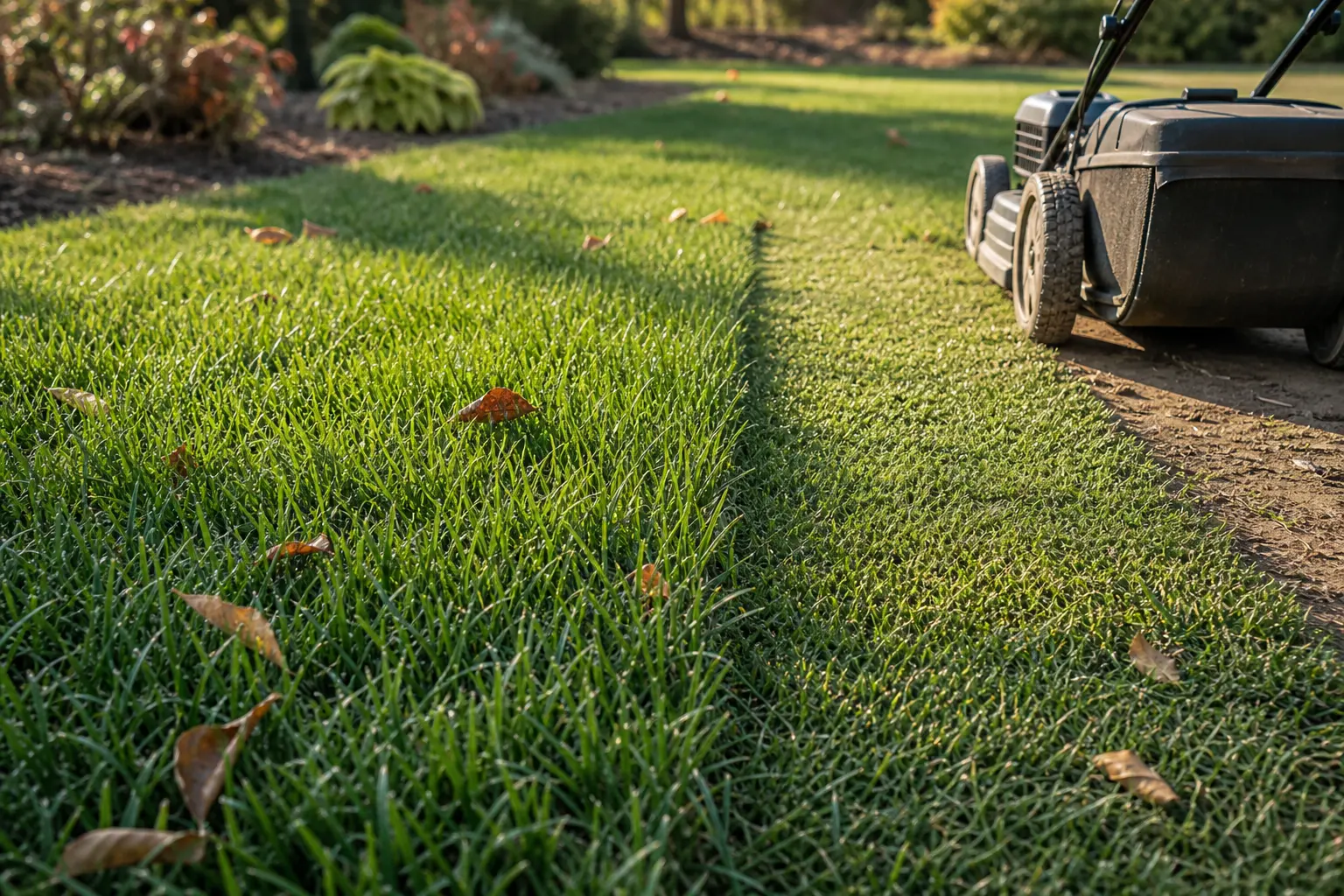
The decision: mow only when most seedlings are tall enough and the soil can carry the mower
For a newly seeded or overseeded **cool-season lawn**—such as tall fescue, perennial ryegrass, or Kentucky bluegrass—the first mow is a growth milestone, not a calendar appointment.
If your normal mowing height will be 3 inches, start considering a first cut when most of the new grass is about 4 inches tall. That is one-third taller than the intended height, leaving room to follow the one-third rule: remove no more than one-third of the leaf blade in one mowing. University of Maryland Extension notes that a first mowing often comes four to six weeks after seeding in good conditions, but height is the more useful field check. S1
Then check the ground. Step gently into a representative part of the lawn. If the seedlings stay pressed down, your footprint remains deep, or mower wheels would leave ruts, wait for a drier day. A few extra days of growth are usually less damaging than running a mower across soft soil. S1S2
A quick call: mow, wait, or mow around it
**Mow now** when most seedlings are at the height trigger, the soil is firm, and the grass springs back after a careful step.
**Wait a few days** when recent rain or irrigation has left the surface soft, footprints linger, seedlings stay flattened, or most new grass is still too short.
**Mow only the established surrounding turf** when older grass has become tall but the newly seeded area cannot yet handle mower traffic. Keep wheels off the tender section rather than lowering the deck to tidy the whole lawn.
This guidance is for cool-season lawns seeded in the late-summer to early-fall window. Do not apply its timing or cutting-height assumptions to warm-season lawns such as bermudagrass, zoysiagrass, centipedegrass, or St. Augustinegrass; their seasonal care differs. S1S4S5
Keep the first cut light and uneventful
Set the mower deck before you start. Use a sharp blade, mow only when the soil is firm enough not to rut, and take off no more than one-third of the leaf blade. A dull blade can tear young leaves rather than cut them cleanly, while a severe first cut asks seedlings to recover from too much stress at once. S1S2
A lighter walk-behind mower can be a practical choice for this first pass if it is available. Whatever mower you use, avoid tight turns and especially avoid pivoting a wheel in one place on a soft patch. Do not mow immediately after irrigation or rain just because the grass has reached the right height.
You do not need a perfectly uniform lawn after this pass. The goal is a clean, shallow cut—not a dramatic correction. If clipping volume would be heavy, that is a sign you waited too long or need to take the lawn down gradually while still respecting the one-third rule.
Don’t scalp a mixed overseeding to match the fastest grass
An overseeded lawn rarely grows evenly at first. Perennial ryegrass and tall fescue can reach mowing height before slower Kentucky bluegrass, and sunny areas often outpace shaded ones.
Keep the deck set for your intended lawn height. Do not lower it to chase a few fast blades or make the lawn look even. If only scattered patches are tall, wait. If most of the lawn has reached the height trigger but a few areas remain thin or short, make a careful pass over the established portion and minimize traffic through those tender spots.
Change watering as the seedlings establish
During germination, the surface needs consistent moisture. As seedlings establish roots, shift gradually toward less-frequent, deeper watering rather than keeping the surface wet by habit. Adjust for rainfall, heat, shade, soil, and how quickly the lawn is drying. S1S2
This does not mean letting a young seedbed dry out. It means using the lawn’s condition, not a fixed sprinkler schedule, to decide when water is needed. If rain has kept the soil saturated, hold off on irrigation and give the surface time to firm before mowing.
Hold off on traffic and weed control
Limit foot traffic until the new turf has been mown at least twice. That gives seedlings more time to anchor before regular use. S1S2
Broadleaf weeds can wait, too. University of Maryland Extension advises waiting until new turf has had several mowings before treating broadleaf weeds. S1S2 The specific product label—and applicable local requirements—controls whether a herbicide can be used on your grass species at its current age, under current weather conditions, and around any reseeding plans. S3
The day before mowing, make one simple check: are most seedlings tall enough, is the ground firm, and can your mower make a clean, light cut? If all three answers are yes, mow. If not, give the lawn a little more time.