Make compost earn its place
Use compost with overseeding when it will solve a specific problem: a modestly poor surface, shallow unevenness, a disturbed patch, or a seedbed that needs help holding moisture. Skip it when the real reason grass is thin is deep shade, tree-root competition, poor drainage, recurring pest damage, or a grass type that does not fit the site. Compost can improve the scene without changing the plot.
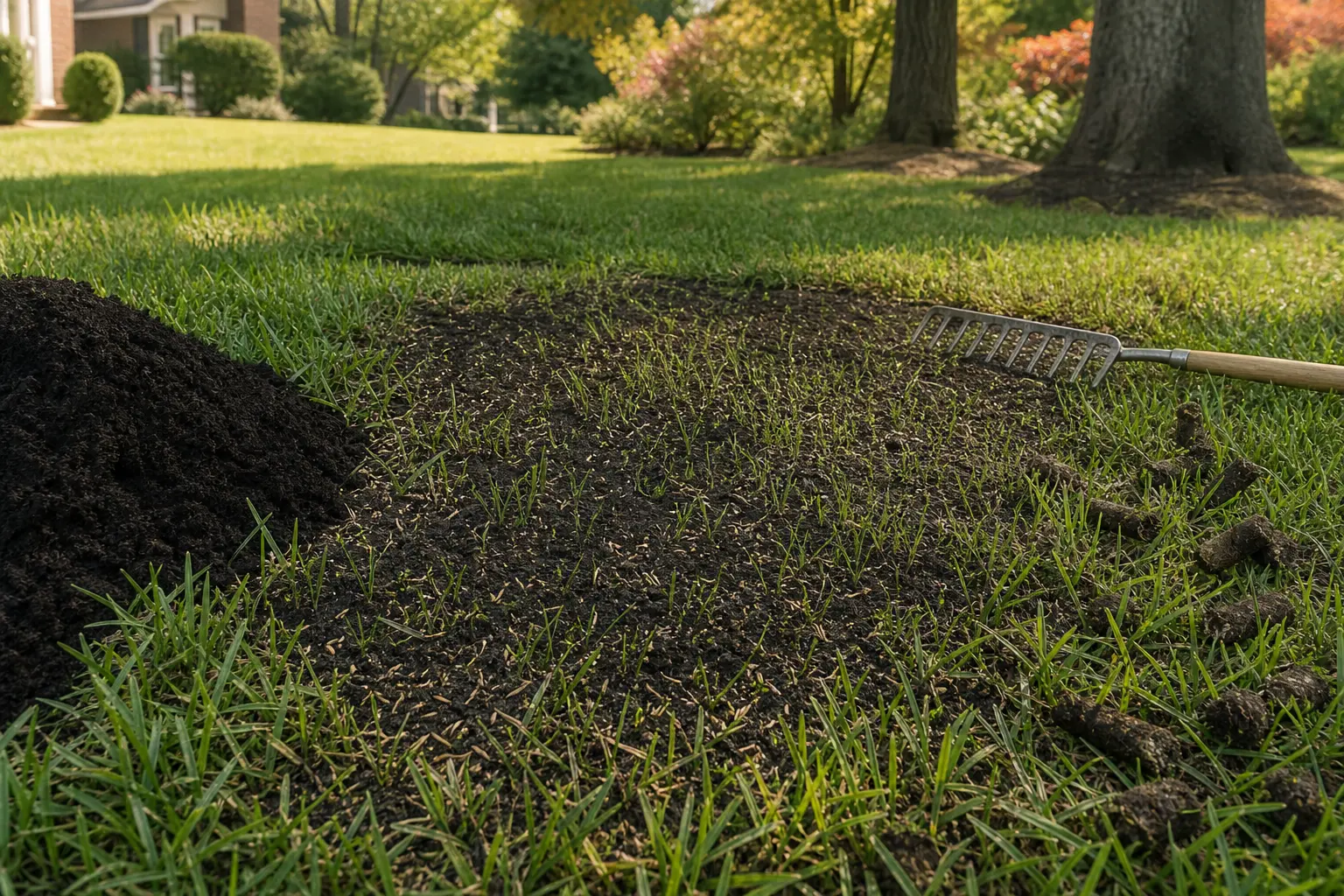
For an established lawn, the safe default is a thin, even topdressing—not a blanket. University of Delaware recommends about 1/8 to 1/4 inch on an existing turf stand, worked into the canopy by raking or dragging. S2 If the seed disappears beneath a thick layer, it is too deep for this job.
This is most relevant for cool-season lawns in their fall overseeding window. Warm-season lawns may be nearing dormancy in many regions, so their renovation timing needs a separate local check.
Ask what is actually making the lawn thin
Before ordering compost, look at the pattern. A thin strip along a walkway may point to traffic compaction. A broad thin area under mature trees may point to shade and root competition. A low spot that stays wet after rain points to drainage. None of those is automatically a compost problem.
A screwdriver test can be useful: compare a trafficked area with a healthier nearby area. If the screwdriver meets much more resistance only where people, pets, or equipment travel, compaction may be part of the story. In that case, core aeration can help by removing plugs of soil; do it when soil is moist but not wet enough to rut under equipment. S6
Do not aerate by ritual, either. If there is no compaction pattern and the turf is thinning because it receives too little light, better seedbed material will not create enough sun.
Buy compost by its analysis, not its halo
Choose mature, screened compost with a current analysis from the supplier. Delaware Extension specifically advises checking compost quality, including soluble salts, carbon-to-nitrogen ratio, and possible contaminants. S2 “Organic” describes an input category, not a guarantee that a material is low-salt, finished, or appropriate for a lawn.
Material source matters. In research on disturbed soil, composted leaf and yard waste improved fertility and turf-establishment conditions, while some other organic amendments created tradeoffs such as nitrogen immobilization or increased nitrogen leaching. S5 That is a good reason to ask what is in the compost rather than treating every dark bag as interchangeable magic dirt.
Keep the layer thin enough to see the lawn
For an existing stand, spread roughly 1/8 to 1/4 inch as evenly as possible, then rake or drag it into the turf canopy. S2 The goal is to fill small voids and improve the immediate surface, not create separate compost islands.
If you are repairing a truly bare patch or constructing a new seedbed, preparation can be different from topdressing living turf. Do not use the existing-lawn depth as a universal rule for every bare-soil project.
After the first watering, inspect the surface. You should still be able to see grass blades and identify the seedbed. Thick mats, buried seed, or piled material along edges are signs to redistribute it while the job is still easy to fix.
Put compost and seed together without burying the seed
Mow, remove excess clippings, and aerate only where the lawn needs it. Then use the thin compost layer as part of the seedbed preparation.
Seed can go on before or after compost, according to the method, as long as it remains close to the surface and has reliable moisture for germination. Oregon State Extension allows either order when combining compost and overseeding. S1 A practical approach is to spread and work in the compost first, seed, then make only a light final pass to settle seed into contact with the surface. If you seed first, avoid a heavy follow-up layer that buries it.
Keep the surface evenly moist through germination. Compost is not a substitute for watering discipline; unfortunately, grass seed has never accepted “but I added compost” as an excuse.
Count compost as part of the fertility plan
Compost contributes nutrients, including nitrogen and phosphorus, so it does not sit outside your fertilizer plan. University of Maryland Extension advises counting compost nutrients toward annual nutrient applications and notes that a compost analysis is different from a soil test. S3
Use a soil test to guide phosphorus, potassium, and pH decisions. Then compare that result with the compost analysis and any planned starter fertilizer. Follow fertilizer and seed labels, and check applicable state or local nutrient rules, especially where phosphorus use is restricted.
Compost topdressing has improved Kentucky bluegrass quality and shoot growth in field research, but the response included compost’s slow-release nutrient contribution. S4 That supports measured use and nutrient accounting—not the idea that more compost is automatically better.
The next decision
If your lawn has enough light, a workable moisture plan, and a modest surface or seedbed problem, use a thin layer of screened, analyzed compost and keep seed near the surface. If the lawn is thin for a deeper reason, pause before the wheelbarrow endurance event and address that cause first.
Timely local weather and your yard’s recent fertilizer history can sharpen this call: soil that is too wet for aeration, a dry forecast that strains watering capacity, or a recent nutrient application may all be reasons to adjust the plan rather than follow a renovation script.