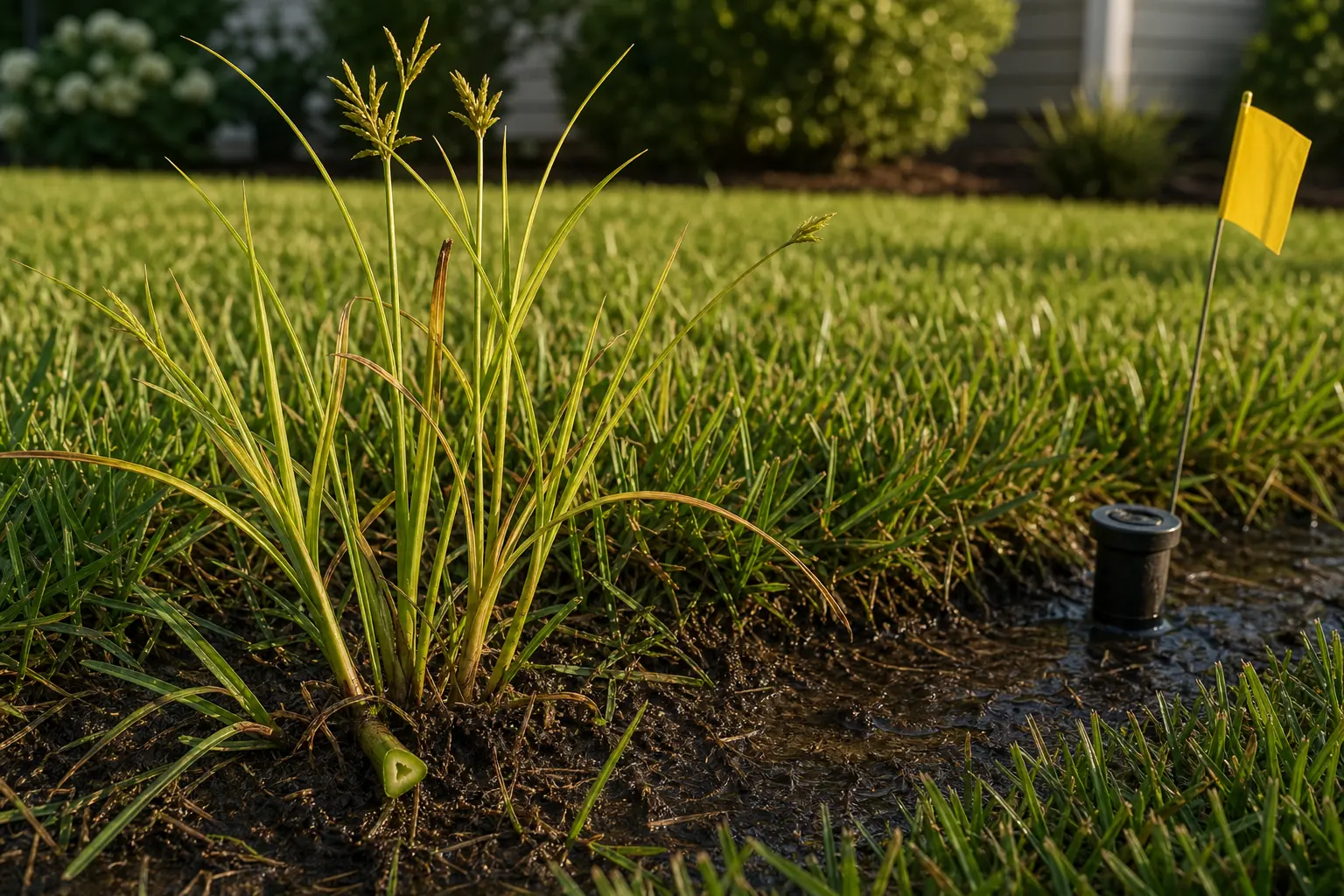
That bright yellow-green clump above the mower line is not automatically crabgrass, and it is not a reason to spray the whole lawn. If the stem is triangular, treat it as a sedge problem instead: dig a small young patch, consider a selective spot treatment for an established patch, and check whether that section of lawn is getting more water than it needs.
First, confirm that it is a sedge
Yellow nutsedge is often more yellow-green than the surrounding turf and can grow quickly enough to stand out again soon after mowing. The most useful at-home clue is its distinctly triangular stem. Gently roll a stem between your fingers, or cut one and inspect the cross-section. Grasses usually have round or flattened stems; sedges have noticeable edges. S4
That clue narrows the diagnosis, but it does not prove the plant is yellow nutsedge. Green kyllinga and other sedges can also have triangular stems. If the color and growth habit do not fit, get a clear photo confirmed by local Extension staff or a reliable local plant-identification service before choosing a product.
Choose the response that fits the patch
**Small and young:** Hand removal is reasonable. Dig out the plant rather than just pulling off the top growth, and remove as much of the underground portion as practical. University of Maryland Extension includes mechanical removal in its guidance for young yellow nutsedge infestations. S1
**Established, spreading, or returning for weeks:** Repeated pulling may not finish the job. Yellow nutsedge can form underground rhizomes and nutlets—small tubers that help it persist—and nutlet formation can begin early. An established patch may therefore require more than one round of management. S4
For that larger or recurring patch, a selective spot treatment labeled for use on your turf may be the practical next step. Maryland Extension identifies halosulfuron and sulfentrazone as active ingredients used for yellow nutsedge in lawns. S1
The active ingredient is only a starting point, not a shopping list. Before applying anything, confirm that the exact label lists your turf species, yellow nutsedge, and the use you have in mind. Also check its temperature and weather limits, mowing directions, rainfall precautions, surfactant requirements, and reseeding restrictions. Those details vary by product; the label and applicable local law control. S2
For one or two patches, a blanket lawn treatment is usually more than the problem calls for. Flag the area, act only after a sound identification, and watch for regrowth.
Check why that spot stays inviting
A wet area is a useful clue, not proof that moisture caused the infestation. Yellow nutsedge can tolerate drier conditions once established. Still, frequent shallow watering favors it, while established lawns generally do better with deeper, less-frequent irrigation adjusted to the site rather than a fixed timer schedule. S3
Look at the exact patch, not just the irrigation controller. Does it sit in a low spot that catches runoff? Does the soil stay damp after the rest of the lawn begins to dry? Is a sprinkler head leaking, overlapping too heavily, or watering that zone too often? Compacted soil and poor drainage can also keep an area wet longer than it should.
Dense turf and watering only as needed are part of yellow nutsedge management. S1 Do not withhold water until the lawn is stressed. Instead, eliminate unnecessary frequent watering and find out why one area stays wetter than the rest. If the spot remains soggy, improving drainage, relieving compaction, or correcting sprinkler coverage may do more for next year’s patch than escalating herbicide.
Spend one week watching the patch
Flag the patch before mowing so it is easy to find again. Over the next week, note two things: whether the plant rises above nearby turf faster after mowing, and whether that soil stays wet longer after irrigation or rain.
Then make the smallest effective move. Dig a small young patch. For an established or expanding patch, confirm the identification and use a selective, turf-labeled spot treatment only if the label fits your turf, weather, and seeding plans. Either way, adjust the water problem at the same time. That is usually more productive than treating the entire yard like it has a weed emergency.