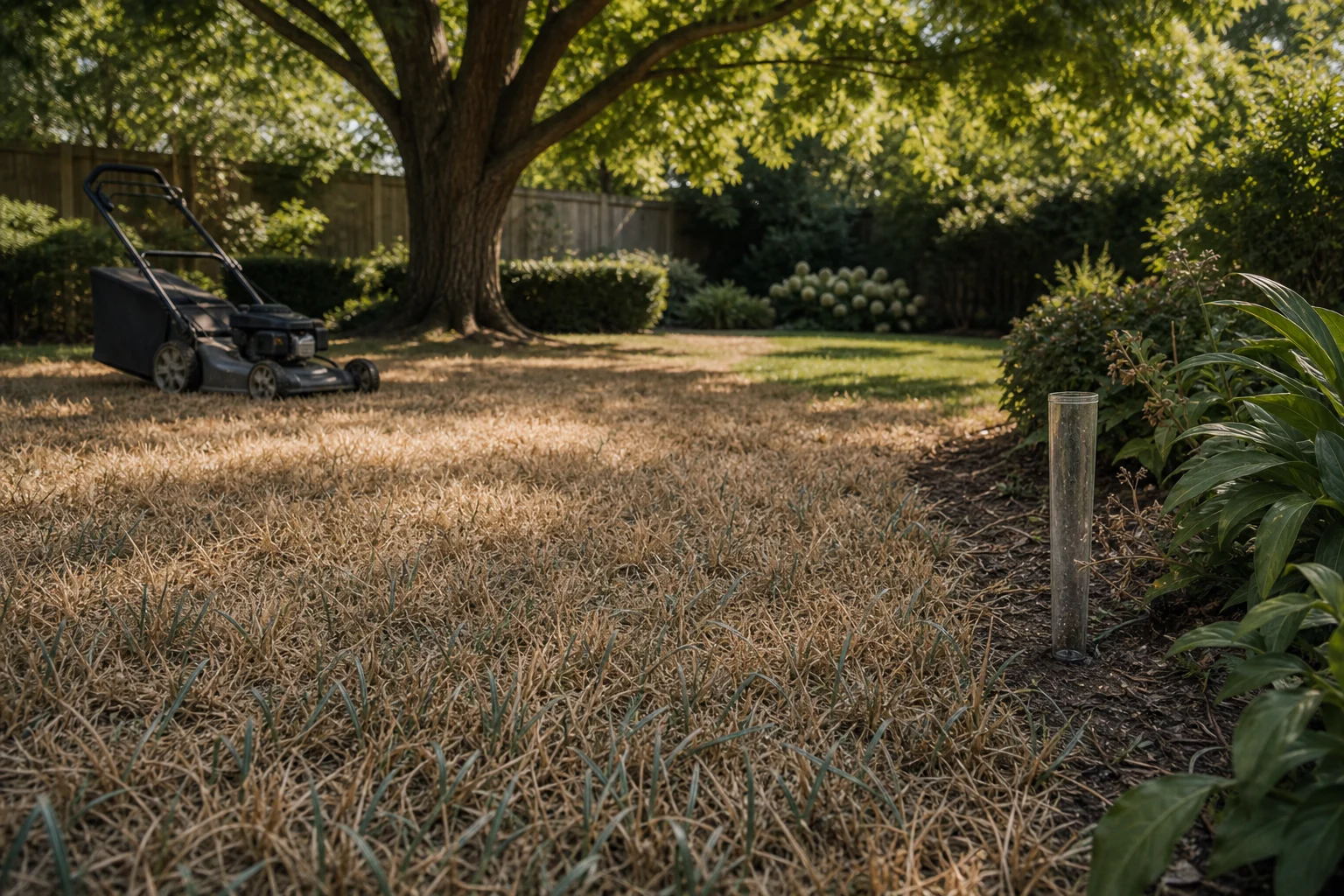
First: brown does not automatically mean dead
For an established cool-season lawn, August brown can be summer dormancy: a heat-and-drought response in which the crowns and roots remain alive while top growth pauses. Kentucky bluegrass and other cool-season turf can commonly stay dormant for roughly four to six weeks without major injury. S1
That is permission to pause the lawn-care pile-on. A brown lawn is frustrating; turning it into a different project every Saturday usually does not help. Start by deciding whether the lawn is still actively growing, safely resting, or needs limited support through an unusually long dry spell.
This guide is for established cool-season turf such as Kentucky bluegrass, perennial ryegrass, and fescues. New seed, recent sod, and warm-season lawns belong on a separate path.
Take five minutes to look before acting
Walk the lawn and note what you see:
- Check recent rain, irrigation, and whether your watering is reaching the brown areas evenly.
- Look for a dull blue-gray cast or folded and rolled blades—common drought-stress signals.
- Step on the grass. Footprints that remain can indicate that the turf lacks moisture and is not springing back.
- Ask whether it has actually grown since the last mow. If it has not, mowing is not urgent.
- Notice whether brownness is broad and fairly uniform or confined to rings, stripes, sunny edges, one irrigation zone, or other repeating patterns.
- Take a close photo and write down the date, recent rain or irrigation, footprint response, and growth. That small record makes the next decision much less guessy.
A lawn that has slowed broadly after hot, dry weather is a good dormancy candidate. A recurring or sharply patterned patch is not automatically drought. Uneven irrigation coverage, compaction, shade, insects, disease, and past construction damage can all create a different problem.
Choose one watering path
Path 1: Maintain an actively growing green lawn
Choose this only if water is available, local watering rules allow it, and you can keep up a consistent, deeper irrigation program. University guidance emphasizes making a deliberate choice between maintaining growth with irrigation and allowing dormancy, rather than relying on frequent light watering. S2
This is the higher-input path. Watch the lawn’s response and make sure coverage is even. If restrictions, cost, or a changing forecast make that commitment unrealistic, shift deliberately to one of the other paths instead of repeatedly greening up and stressing the lawn.
Path 2: Let an established lawn rest
If the lawn is established, drought-driven brownness is widespread, and you cannot sustain irrigation, dormancy can be the sensible stewardship choice. Avoid unnecessary mower traffic while turf is heat- and drought-stressed. S1
Do not expect a dormant lawn to look great in August. The goal is survival until cooler temperatures and meaningful moisture support recovery—not winning an imaginary lawn pageant during a drought.
Path 3: Use limited survival water during a prolonged dry spell
If drought continues beyond the period an established cool-season lawn can usually tolerate dormant without major injury, consider limited watering intended to protect living crowns rather than to create instant green-up. S1
There is no universal schedule for this. Soil texture, grass species, rainfall, irrigation output, heat, and local rules all matter. Check municipal or utility restrictions first; applicable law and any local watering rules control. The practical aim is to avoid repeatedly waking the lawn during hot weather while giving it enough support to survive an extended dry spell. S1S2
Mow only when there is growth to mow
If drought-stressed turf has stopped growing, postpone mowing. Mower traffic adds stress, and mowing dormant grass does not produce a healthier lawn. S1
When moisture and cooler conditions restart growth, return gradually:
- Set the mower toward the higher end of the recommended range for your grass type; higher mowing helps reduce summer stress. S1S2
- Keep blades sharp.
- Remove no more than one-third of the leaf blade in one mowing.
- Avoid trying to “catch up” with one aggressive cut.
Put fertilizer and broadleaf weed treatment on hold
Do not use fertilizer as a quick-green fix for drought-stressed cool-season turf. Extension guidance recommends waiting until moisture returns and the grass is actively growing; nutrients the lawn cannot use can also contribute to environmental harm. S1S2
Likewise, hold broadleaf weed treatment while both weeds and turf are drought-stressed. Better timing is after moisture has returned, turf has resumed active growth, and your local seasonal window supports the work. S2
If you later choose any pesticide product, the product label and applicable law control. Do not substitute a generic lawn guide for label directions.
Know when this is not a “let it rest” situation
Newly seeded and recently sodded lawns have shallower root systems and face greater risk if they dry down hard, so do not assume they can safely follow the dormancy plan for an established lawn. S1
Also take a closer look when:
- The lawn is warm-season turf; recovery and late-season fertility decisions differ by grass type. S5
- Brown areas follow a distinct pattern, remain isolated, or do not match irrigation coverage.
- Orange or rust-colored powder rubs off on shoes or hands. Turf rust can show as orange-yellow to reddish-brown spores and is often associated with stressed or slow-growing turf. S3S4
- The lawn receives favorable moisture and cooler conditions but particular areas still do not produce new growth.
For rust-like symptoms, cultural recovery—appropriate mowing, reducing stress, and helping turf resume healthy growth—is generally the first home-lawn focus; fungicide decisions require careful diagnosis and label-aware use. S3S4
What to do next
Today, pick one path instead of stacking four chores:
- If you can reliably water, maintain active growth consistently.
- If this is an established lawn and irrigation is not realistic, let it rest and reduce traffic.
- If the drought is prolonged, consider limited survival water within local rules.
Then wait for a meaningful change—substantial moisture, cooler weather, or renewed growth—before deciding on mowing, fertility, weed control, or repairs. Timely local weather and watering-rule signals can help you choose when to reassess, but they cannot diagnose a patch from afar or guarantee recovery. Your notes and photos will show whether the lawn is waking up or whether a specific area deserves a closer diagnosis.