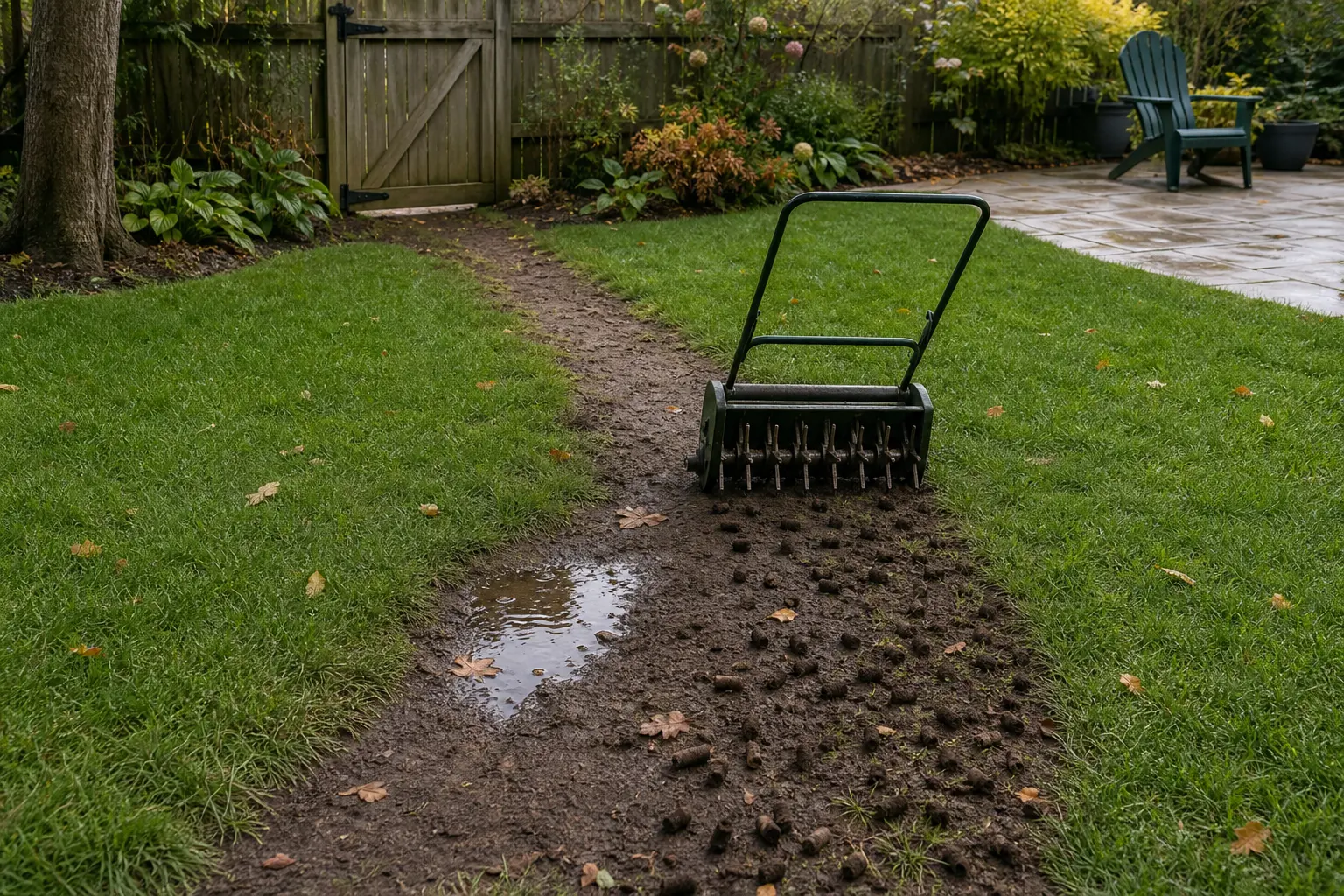
The decision: rent, spot-aerate, or skip it?
Skip the automatic annual rental unless your lawn is giving you a reason to suspect compaction. Core aeration is most useful where soil has been pressed tight enough to limit water entry and root growth—not simply where grass looks tired after summer. Reduced infiltration, ponding, runoff, and restricted rooting are all associated with compaction. S1
A whole-lawn pass makes sense when those symptoms show up broadly. If the trouble follows the dog run, gate path, play area, curb strip, or the route construction equipment used, treat that zone first. Maryland Extension recommends basing aeration frequency on traffic and soil conditions rather than treating it as an automatic yearly chore. S3
Look for a compaction pattern, not a thin-grass panic
Walk the yard after a solid rain or normal irrigation. Flag places where water puddles, runs off, or takes noticeably longer to soak in. Then check whether the surface feels unusually hard and whether the weak turf is concentrated where feet, wheels, or equipment repeatedly pass. Those clues make compaction worth investigating. [S1, S3]
Thin grass alone is not enough. Shade, drought stress, uneven irrigation, mowing stress, insects, disease, and poor seedling establishment can all leave turf sparse without making aeration the fix. If a weak area does not match a traffic or water-infiltration pattern, solve the underlying problem before renting a machine. Aeration is helpful for the wrong problem in much the same way a snow shovel is helpful for a leaky faucet.
Do not treat aeration as a universal thatch or organic-matter cure, either. Research on intensively managed putting greens found that outcomes varied with the aerification approach and site conditions, and core aerification did not automatically reduce organic matter over time. That work is not a home-lawn prescription, but it is a useful reminder not to expect one pass to solve every soil issue. S2
If you aerate, use the tool that actually removes cores
Choose a hollow-tine, or core, aerator. Its hollow tines remove plugs of soil and leave open channels behind, creating meaningful surface disruption and improving aeration in compacted turf. UMass Extension identifies hollow-tine coring as the most effective listed cultivation method for improving aeration and alleviating compaction. S1
Spike tools and shallow slicing machines make holes, but they are less effective than hollow-tine coring for relieving compaction. S1 If a rental is described as a spike aerator or slicer, it is not the equivalent of a core aerator for this job.
Before committing to the whole yard, make a short test pass. A suitable core aerator should pull intact soil cores rather than merely scratch the surface or leave crumbling dust. Maryland Extension describes core aeration as removing soil plugs roughly 2.5 to 4 inches deep. S3
Fall works when the lawn and soil are ready
For cool-season turf, early fall is a favorable recovery period because the grass is actively growing, and Maryland Extension lists fall as the preferred time for core aeration. S3
The calendar is not the final call. Wait if the lawn is drought-stressed or the soil is so dry that the machine cannot pull real cores. Also wait when soil is wet enough that the machine will rut or compact it further; heavy traffic on wet soil can worsen compaction. [S1, S3]
Avoid aerating dormant, waterlogged, or newly seeded turf. If the lawn has recently received a pesticide or other regulated treatment, follow that product label and applicable local law before disturbing the turf.
If you also plan to overseed, confirm that the local seeding window is still appropriate for your grass type and climate. Core holes can create useful seed-to-soil contact, but aeration does not extend a closing seeding window or rescue seed from unsuitable weather.
Make the smallest useful pass
After the next rain, map the puddles, runoff paths, and worn traffic lanes. If the signs cluster in a few places, rent or hire for those places rather than giving every square foot the same treatment. If the symptoms are widespread and the turf is actively growing, a whole-lawn core aeration may be justified. [S1, S3]
The practical test is simple: can the machine pull intact cores without rutting the lawn, and are you addressing a water-and-traffic pattern rather than a mystery patch? If yes, aeration has a job to do. If not, keep the rental fee for the diagnosis your lawn actually needs. Timely local rain, soil-moisture, and growth signals can help narrow that call, especially when the forecast is doing its usual fall mood swings.